
What is Profit-Driven Cybersecurity?
The Paradigm Shift: From Cost Center to Revenue Driver
Traditionally, cybersecurity has been viewed as a “digital insurance policy”—a necessary expense to prevent loss. Profit-Driven Cybersecurity rejects this speculative ROI argument. Instead, it focuses on how information security initiatives actively drive the business forward, unlock new revenue streams, and create a competitive “moat”.
In the current digital age, organizations that leverage security as a strategic asset trade at a premium because their growth is predictable and their liabilities are capped.
The ISPPP Framework
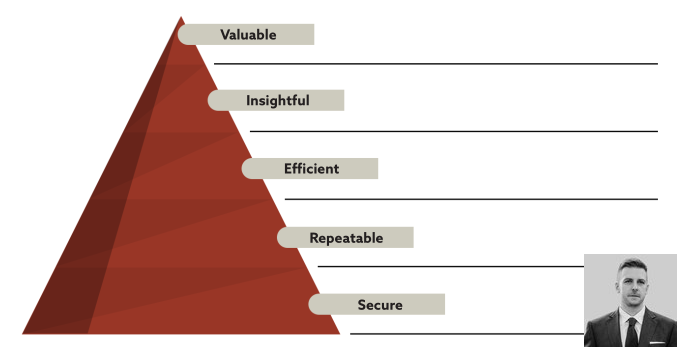
At the heart of this philosophy is the Information Security Program Progression Pyramid (ISPPP). Most security teams get stuck at “Compliance” or “Security”. Profit-Driven Cybersecurity is about ascending to the capstone:
Secure & Repeatable: The fundamentals. Protecting assets and ensuring processes are known and consistent.
Efficient: Integrating security tools with business systems to foster automation and scalability.
Insightful: Leveraging analytics and dashboards to facilitate data-driven executive decision-making.
Valuable: The ultimate stage where the security program becomes a primary driver of business growth.
Four Pillars of Profit Growth
Profit-Driven Cybersecurity focuses on four actionable areas where security directly impacts the balance sheet:
Security Certifications (The Sales Booster): Using standards like ISO 27001 and SOC 2 to build instant trust with high-value clients, differentiate from competitors, and win premium contracts.
Security Analytics & BI: Integrating security data with Business Intelligence to identify new market trends, optimize product placement, and detect fraud with real-time visibility.
Complexity Theory Risk Management: Moving beyond linear risk models to understand the “systemic interdependencies” of your organization, allowing for more efficient resource allocation and capital preservation.
Strategic Crisis Management: Transforming your incident response into a reputation-building asset that maintains customer trust and minimizes financial impact during a breach.
Is Your Security Program Ready?
Profit-Driven Cybersecurity is intended for the CEO who wants to maximize organizational potential and the CISO who wants a seat at the executive table. It requires a shift in mindset: viewing security not as a hurdle, but as the very thing that enables business velocity.
“Financial targets, market expansion, and monetizable innovation are the end goals of a business. To be respected, we must speak the language of the Board.” — Mike Boutwell, Profit-Driven Cybersecurity
Practical 2026 Revenue Generators
1. The Customer Trust Portal (SaaS & Tech)
Sector: Mid-to-Large SaaS.
The Strategy: Moving from “security-by-request” to a public-facing, real-time Security & Compliance Hub.
The Revenue Driver: By providing live, self-service access to your SOC 2 Type 2 reports, ISO 27001 certifications, and penetration test results, you eliminate the “security questionnaire” friction that stalls 6-figure deals for months.
Profit Impact: Shortens the enterprise sales cycle by 30-40%, allowing for faster capital velocity.
2. Supply Chain “Safe Harbor” Status (Manufacturing & Automotive)
Sector: International Manufacturing.
The Strategy: Achieving global certification for all international sites (e.g., the 14-site global certification model) to meet the “Brussels Effect” requirements of the EU AI Act and NIS2.
The Revenue Driver: As global giants de-risk their supply chains, they are purging “unreliable” partners. Holding a Universal Governance Layer makes you the “Preferred Partner” for high-end automotive and industrial contracts.
Profit Impact: Secures multi-year, multi-million dollar contracts that competitors lose due to “Compliance Drag”.
3. Fraud-as-an-Insight Platform (Banking & Fintech)
Sector: Financial Services.
The Strategy: Integrating Security Analytics with Business Intelligence (BI) to detect fraud while simultaneously identifying new consumer trends.
The Revenue Driver: Using the same data used to detect “bot” traffic to identify which regions are seeing a surge in legitimate transaction volume.
Profit Impact: Transforms a fraud-prevention tool into a market-expansion guide, helping the bank target specific, high-growth segments more effectively.
4. The “Agentic Integrity” Audit (Healthcare & AI Service Providers)
Sector: Organizations deploying Autonomous/Agentic AI.
The Strategy: Implementing an immediate Bias and Integrity Audit for any AI used in consequential decision-making (lending, hiring, diagnostics).
The Revenue Driver: Providing a “Fiduciary Validation” to clients that your AI agents won’t trigger massive legal liabilities or “Algorithmic Drift”.
Profit Impact: Allows the company to charge a premium for “Verified Ethical AI,” capturing the high-trust segment of the healthcare and legal markets
The New Fiduciary Reality
The reality is that the era of the “blank check” for information security is over. In a global economy defined by agentic volatility and regulatory convergence, a security program can no longer justify its existence through fear alone.
To survive in 2026, security must not only justify its position on the balance sheet—it must prove that it delivers sales, accelerates capital velocity, and creates measurable value for the business.
I don’t just secure your data. I protect your engine of growth.